
Explore StrandsOS
Never advertise a component
when you can offer a freedom.
Every operating system has windows, files and an app store. This page is about what StrandsOS's design lets you do, and, under each idea, how it works and how far along it is.
Your desktop is wherever you need it
The desktop belongs to you. Not to the machine.
Your desktop is a participant in the fabric, not the centre of it. It works with applications and services running locally, elsewhere in your home, across your organisation or on remote machines. Several people can have their own working environments while sharing the machine underneath. A server runs without any screen at all and is still managed through the same tools.
- One system image starts as a desktop or as a headless server.
- A headless server was installed and administered entirely from a desktop. Nobody typed at the server.
- Two people, two seats, one machine, each with their own login and encrypted home.
- A panel on one machine drives a service running on another.
- A powerful workstation lending its computing power to a lightweight desktop is planned, not built.
Your desktop is where you work. Your computing is wherever it needs to be.
Meet the fabric
Everything connects. Nothing has to do everything.
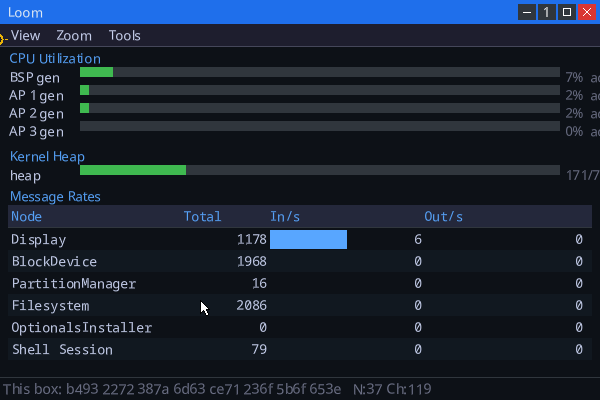
StrandsOS organises computing around cooperating capabilities called nodes. One reads a file, another processes an image, another talks to equipment, another stores results or displays them. Nodes connect through declared, typed channels, so the fabric lets them work together, even when they run on different machines.
Strands treats a node on another machine exactly like one on yours. The same application runs on one box or many, and the way you build it doesn't change.
Build with capabilities, not boundaries.
See your operating system work: Loom
A living map of your computing environment.
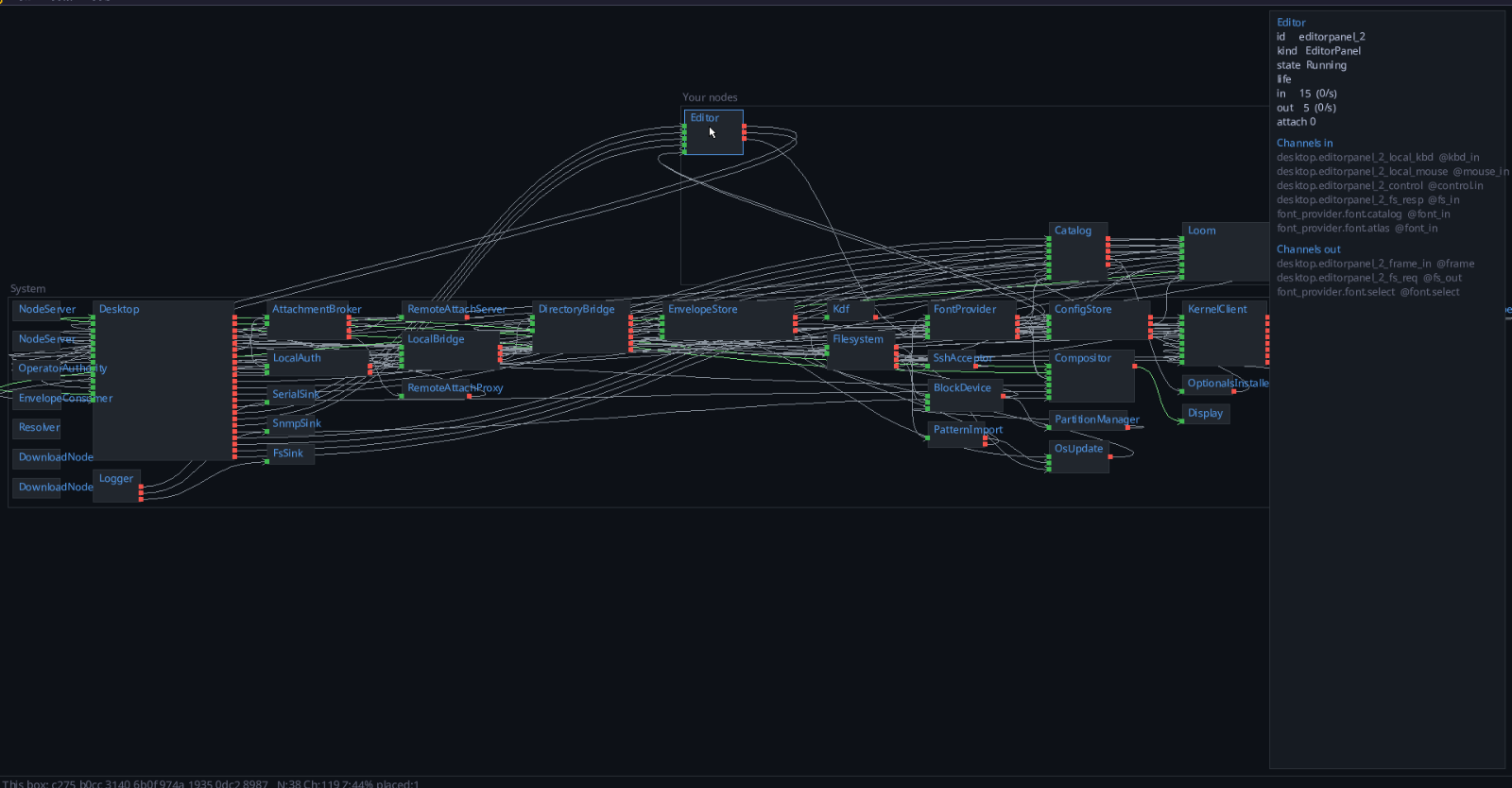
Loom shows the nodes that make up your environment, the connections between them and the activity flowing through them. What is usually hidden behind processes and logs becomes visible and inspectable: click a node to see what it's doing, what it receives and what it sends. Loom can also show the graph of a connected peer machine.
Today Loom shows and explains your system. Composing and rewiring it from the map is planned.
Don't just use your computer. Understand what it's doing.
One system. Many machines.
Put the work where it belongs. Access it where you are.
A desktop on a laptop, processing on a workstation, storage on a server and equipment in a laboratory can all take part in the same fabric. Machines on a network find each other and join only when their owner approves. Your software uses the capabilities it needs without all the work having to live in one box.
Security that travels with your work
Being connected doesn't mean being entitled.
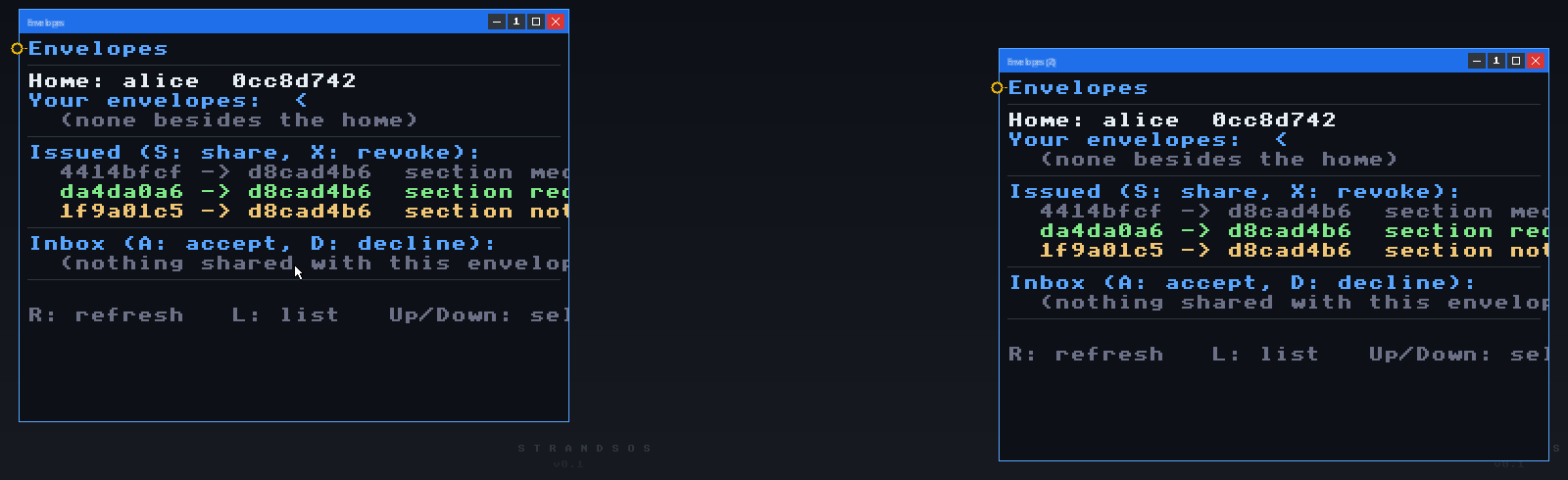
Strands keeps three things separate: who is using a device, what information or capability is involved, and what that person or process is allowed to do with it. Envelopes hold protected information and the authority over it. Signing in doesn't hand over everything: permissions are granted per operation, and checked every time.
StrandsOS has not been independently security-audited or certified. We describe how the design works, not a guarantee.
Your information has an accountable home
More than a location. An accountable home.
Distribution isn't just copying data around. Strands keeps track of which machines hold your information, who is responsible for it, what has been acknowledged and how it is recovered. Custodians can hold copies for you without being able to read them.
- Placement across three machines, with durable acknowledgements of who holds what.
- After a network partition, a returning machine refused stale data, then reconciled.
- A wiped machine was restored from a recovery code plus a copy held by a trusted peer.
Software you can trust
Trust should be established, not assumed.
Software arrives signed, from a catalogue, with a known publisher and a declared list of what it may do. An app from a publisher you haven't chosen to trust is refused. Withdraw your trust in a publisher or a machine, and live connections are cut straight away.
Signing proves where software came from. It doesn't certify that the software is safe.
An OS designed to recover
Progress shouldn't cost you recoverability.
Computers have to survive changes, interruptions and mistakes. A StrandsOS update boots on trial first. If the new version fails to come up, the machine falls back to the last good one by itself. A tampered update is refused at boot, and pulling the power mid-update doesn't leave a broken machine.
Build by connecting what exists
Stop rebuilding the same integration.
Sensor, calculation, storage, display: in Strands each part can be a reusable capability, not a custom integration written from scratch every time. Developers add the missing pieces with the StrandsOS app SDK, and every app is assembled from the same kind of parts as the system itself.
A place for intelligent agents
AI should work with your operating system, not just talk about it.
When every capability has a discoverable interface and explicit authority, agents have something real to work with. They could inspect a workflow, propose connections, diagnose bottlenecks and ask for the permissions they need, always within limits you set.
An assistant and a permission-checked way for agents to use tools are being built. Nothing here is autonomous today.
Intelligence is not authority.