
Developers
Build with capabilities, not boundaries.
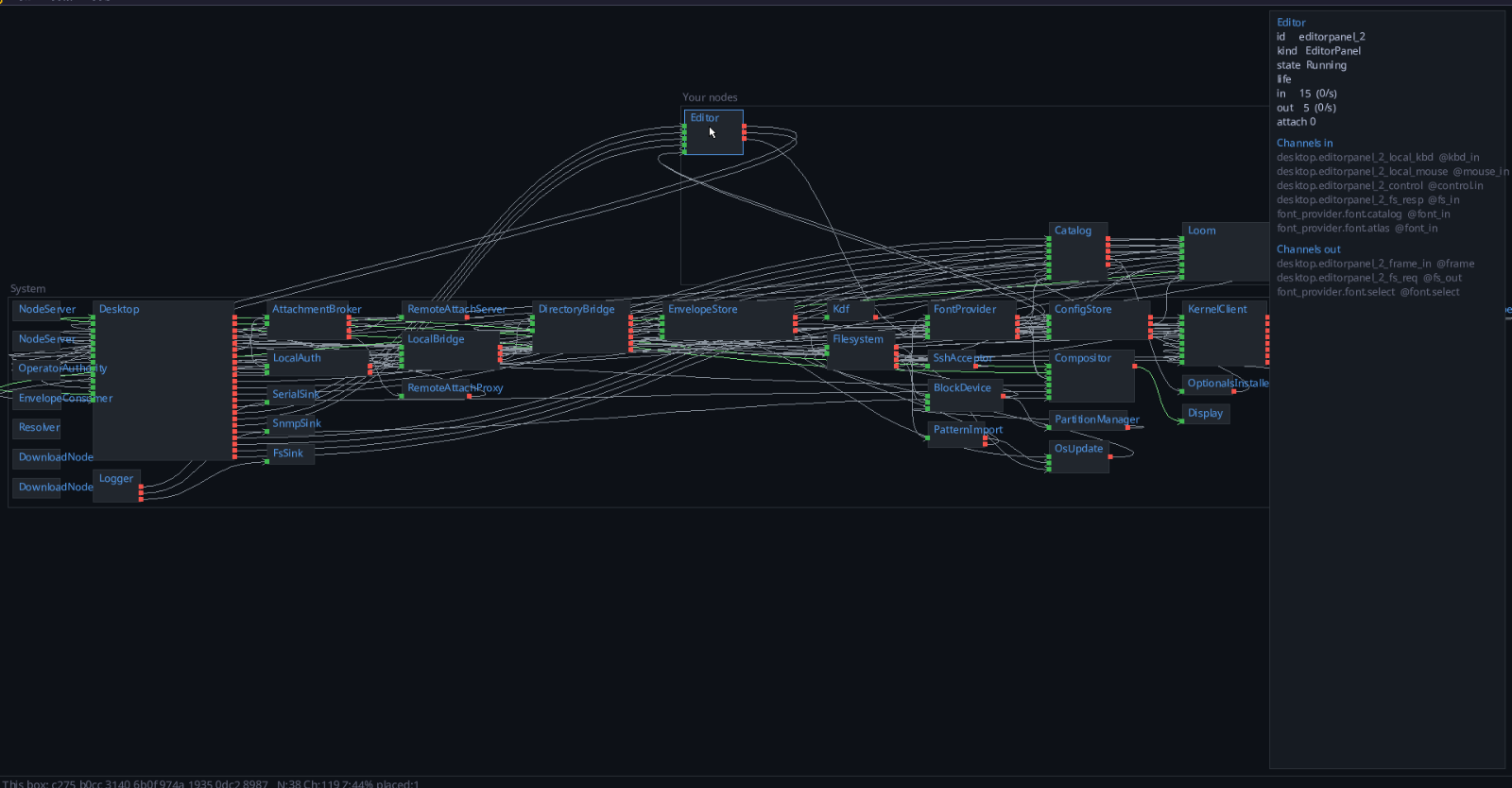
In StrandsOS, an application is an assembly of nodes: small, self-contained pieces connected by declared, typed channels. You write the pieces that don't exist yet and connect them to the ones that do: storage, display, input, other machines.
The app SDK
Apps are written in Rust against the StrandsOS app SDK (version 0.1). It isn't published publicly yet, and its interfaces may still change before 1.0.
Your app, your signature
An app built and signed outside the project has been published to the store, refused until its publisher was trusted, and then installed and run in its sandbox.
Python and more languages
Python nodes and other language integrations are planned. They are not available yet.
The node model, in one minute
- Nodes do one job each and talk only through declared, typed channels.
- Fabrics are nodes wired together. An application is a fabric.
- Panels are the parts people see, and they can attach to nodes on other machines.
- Capabilities are explicit: a node gets only what it has been granted, and the system enforces it.
- Location is transparent: a node on another machine is used exactly like one on yours.
- Loom shows your fabric live, so you can see what your app is actually doing.
What we can't offer yet
No public SDK download, no public documentation site and no open-source licence have been announced. StrandsOS doesn't run existing Linux or Windows software. During early access we work directly with developers who have a real problem to build against.
Tell us what you'd build